嵌入文件
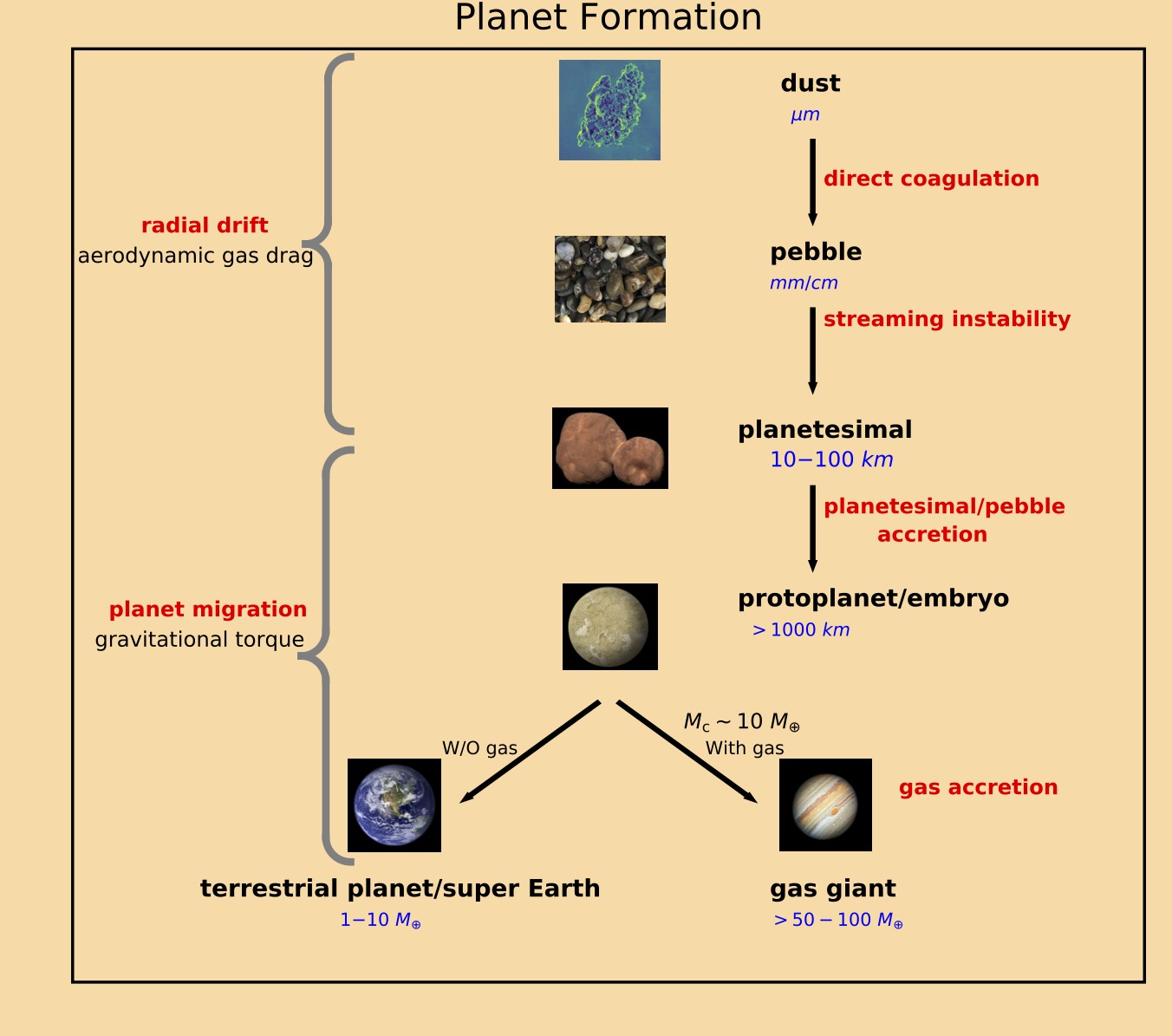
图1:不同尺寸天体参与行星形成的流程图。
For instance, we illustrate in Figure 1 the planetary bodies with different characteristic size. These are micro-sized dust grains, mm/cm sized pebbles, >10km sized planetesimals, >1000 km sized protoplanets and final planets (terrestrial/超级地球 planets or gas 巨行星). The key growth processes that each body increases its size are marked in red text. These planetary bodies also interact with the 原行星盘 gas, causing their orbits to shrink or expand. Such solid-gas interaction is different among different size bodies. For example, the aerodynamical gas drag dominates for smaller size dust grains and pebbles, while the gravitational tidal torque matters for larger size planetesimals and planets.
Figure 2 provides an animation of planetesimal-planet (left) and pebble-planet encounters in a planet-centered co-moving frame. Planetesimals are >10 km bodies and pebbles refer to cm to mm size solid particles. Noticeably, how they get accreted by the planet behave differently. Only the gravitational force matters when the planetesimal interacts with the planet, while the gravitational force and gas drag force jointly contribute when the pebble interaction with the planet. The key difference between these two accretion modes is whether the gas drag plays a significant role during accretion.
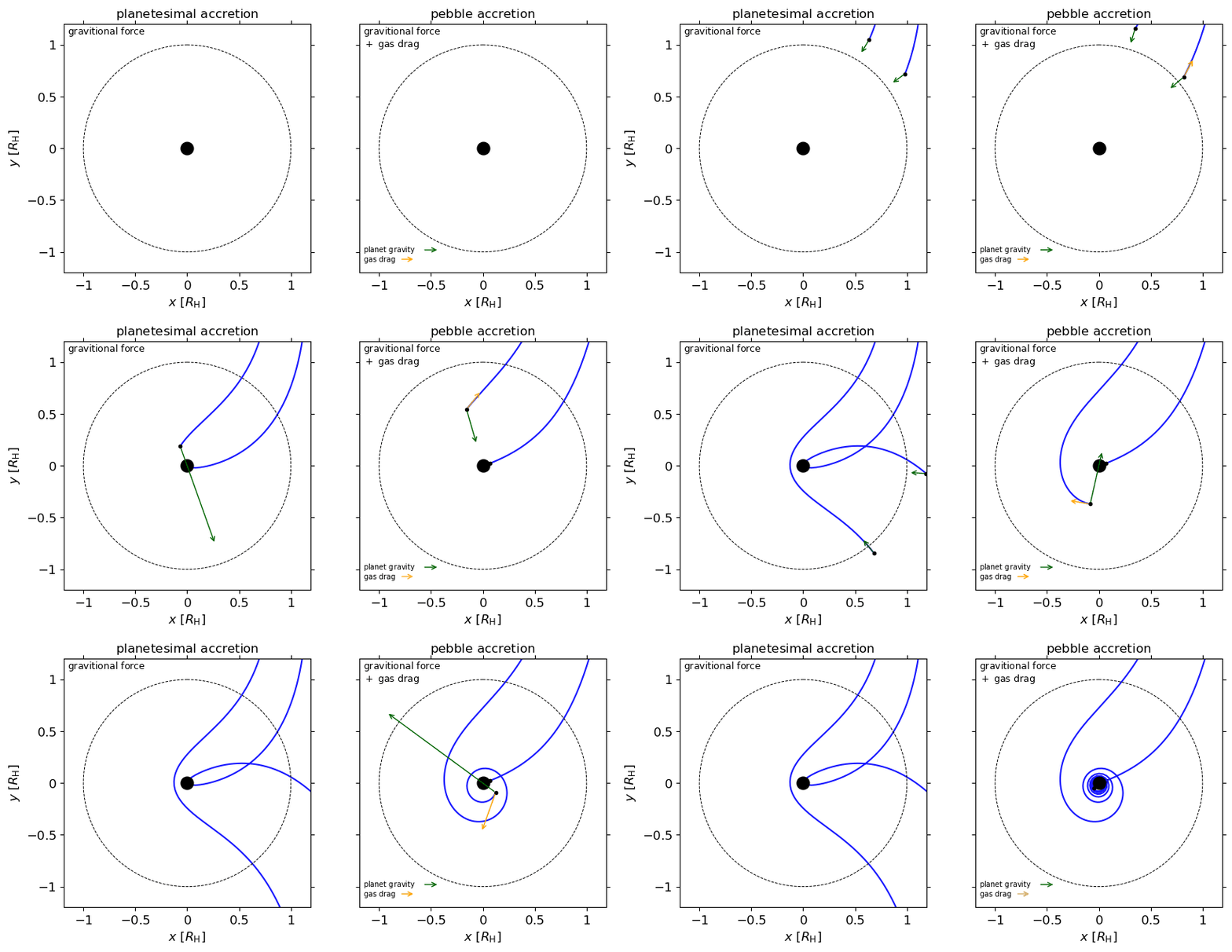
图2:星子吸积与卵石吸积的比较。
页面已更新
Google 协作平台
举报滥用